
Know what your survey data can -and cannot- support before you report it.
DQF is an analyst-led stress test for survey and behavioural datasets. We show which responses are usable, where your sample breaks down, which analyses you can defend, what to fix while collection is still open — and what evidence proves the dataset was checked properly.
Ready for comparison
Gender · 2 outcomes
Needs +94 responses
Group: en
Descriptive only
Country × outcome
Audit evidence attached
12 rules · 3 excl.
Your total N looks fine. That's not the same as knowing what's safe to report.
Most teams discover the limits of their dataset too late — deep in analysis, or worse, once reporting has begun. DQF surfaces them while you can still do something about it.
The dataset is messy and we don't know what's safe to analyse.
Some responses may be junk — incomplete, duplicated, too fast, inconsistent, or structurally invalid.
Our total N looks fine, but the subgroup comparisons may be impossible.
The survey is still running — what should we fix now?
Collection is over — what can we responsibly report?
We need to show a funder or reviewer that we did this properly.
One dataset. Several analytical routes. Different verdicts.
Required evidence is not one universal number. It depends on what the team intends to estimate or compare, the precision or effect it plans for, the usable denominator and the sampling basis. The same dataset can be ready for one route and unsupported for another.
Descriptive proportion
The usable base clears the descriptive requirement. This route is ready.
| Intended use | Single sample proportion |
|---|---|
| Inference scope | In-sample descriptive |
| Sampling basis | Non-probability, quota-balanced |
| Target | ±3.5 pp at 95% |
| Available / required |
4,218 / 1,060
|
Caveat / action
Report as a sample proportion. Do not generalise the figure to national populations.
Every verdict carries its route, denominator, assumptions and the limitation that remains.
From raw responses to decisions you can defend.
Usable base - what actually counts
Which responses are kept, flagged, or excluded - and the rule behind each one.
Subgroup strength - which comparisons hold
Which planned comparisons are supportable and which are underpowered or unsafe.
Reporting boundaries - where the line sits
What to report, caveat, separate, suppress, or defer - stated before reporting starts.
Recruitment unlocks - what more data buys you
Where additional responses would actually change what you can claim - while fieldwork is open.
Audit evidence - proof it was checked properly
A documented trail behind every keep/exclude and every reporting decision - ready for funders, evaluators, and reviewers.
A focused stress test, or the full evidence package.
Pick the entry point that matches where your study is. Both are analyst-led and evidence-bound.
DQF Survey Stress Test
The fastest way to learn what your dataset can carry.
A focused, analyst-led review of a survey or behavioural dataset. We stress-test the evidence against the analyses you actually intend to run, and return a clear verdict on each — supported, supported with a stated caveat, or not supported — with the reason and the limiting factor named.
- Response validity: keep / flag / exclude, with rules
- Usable base and the real denominator per analysis
- Subgroup strength for each planned comparison
- A verdict per intended analytical route
- Reporting boundaries, assumptions & required caveats
- The limiting factor for anything not yet supportable
DQF Raw-to-Report Evidence Package
The full path from raw export to defensible reporting.
The broader engagement. It wraps the Survey Stress Test in documented data preparation and provenance, fieldwork monitoring while collection is still open, and an audit-ready evidence trail — so the dataset reaches the reporting stage already checked, documented, and defensible. Preparation here is transparent and recorded; it is not blind automatic cleaning, and analyst judgement governs every consequential choice.
- Everything in the Survey Stress Test
- Documented data preparation & provenance (transparent, recorded, reproducible)
- Fieldwork & recruitment monitoring while collection is open
- Audit-ready evidence trail for funders, evaluators, and reviewers
Outputs designed for decisions.
Real report excerpts from a recent engagement, with no client-identifiable data. DQF turns survey quality evidence into analysis-readiness and recruitment-planning guidance.
What the finished dataset can responsibly support
- Final analytical-scope verdicts
- Analysis-readiness map across routes
- Reporting boundaries, assumptions & caveats
- Claim/evidence audit trail
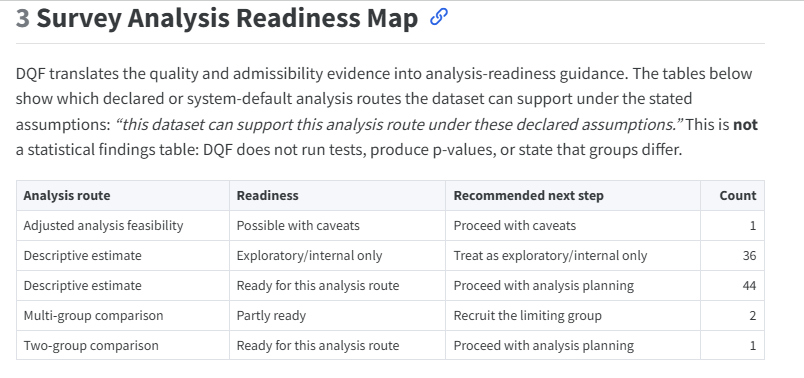
Real report excerpt. No client-identifiable data shown.
What the team should do while collection can still improve
- Current quality status
- Limiting groups
- Route-specific recruitment unlocks
- Operational warnings & actions
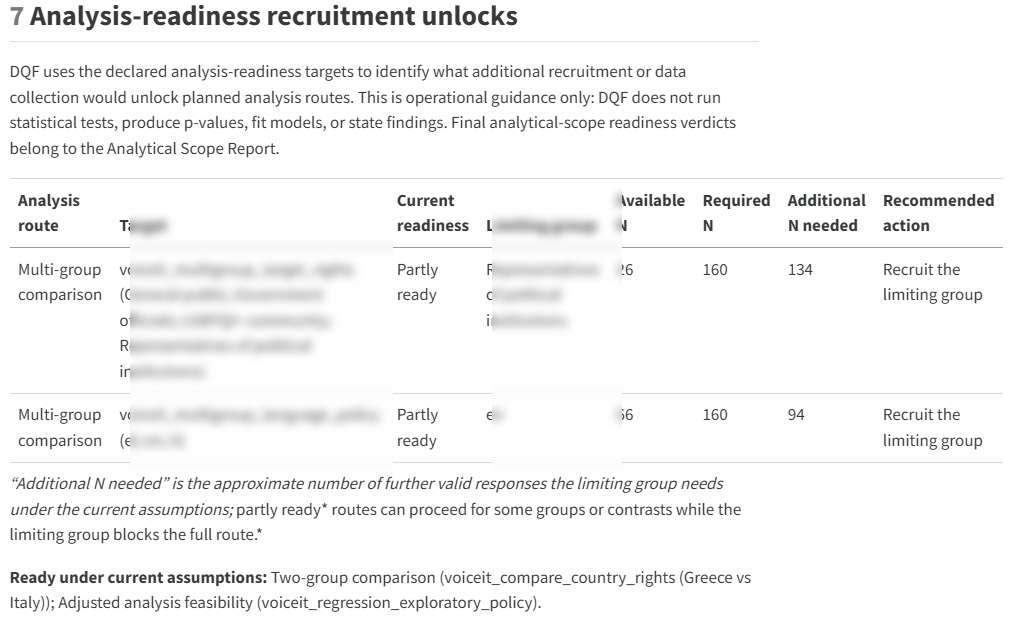
Real report excerpt. No client-identifiable data shown.
Embedded evidence layers
Preview panels are illustrative. Sample artefacts are synthetic — no real client or respondent data.
Synthetic example — no real client data
Demo admissible-claims matrix
Synthetic example. Each intended claim classified as supported, caveated, descriptive-only, suppressed, or blocked.
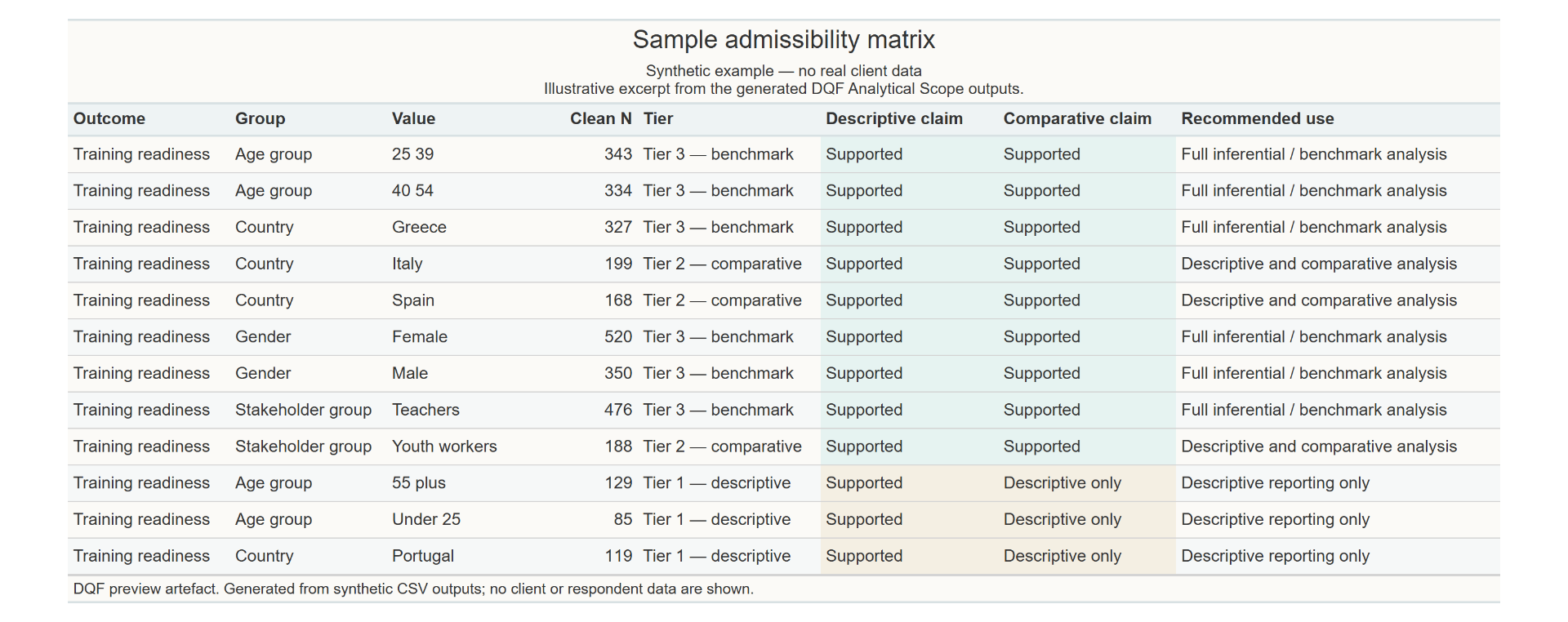
Synthetic example — no real client data
Synthetic recruitment-gap example
Synthetic example. Where additional responses would most improve analytical value.
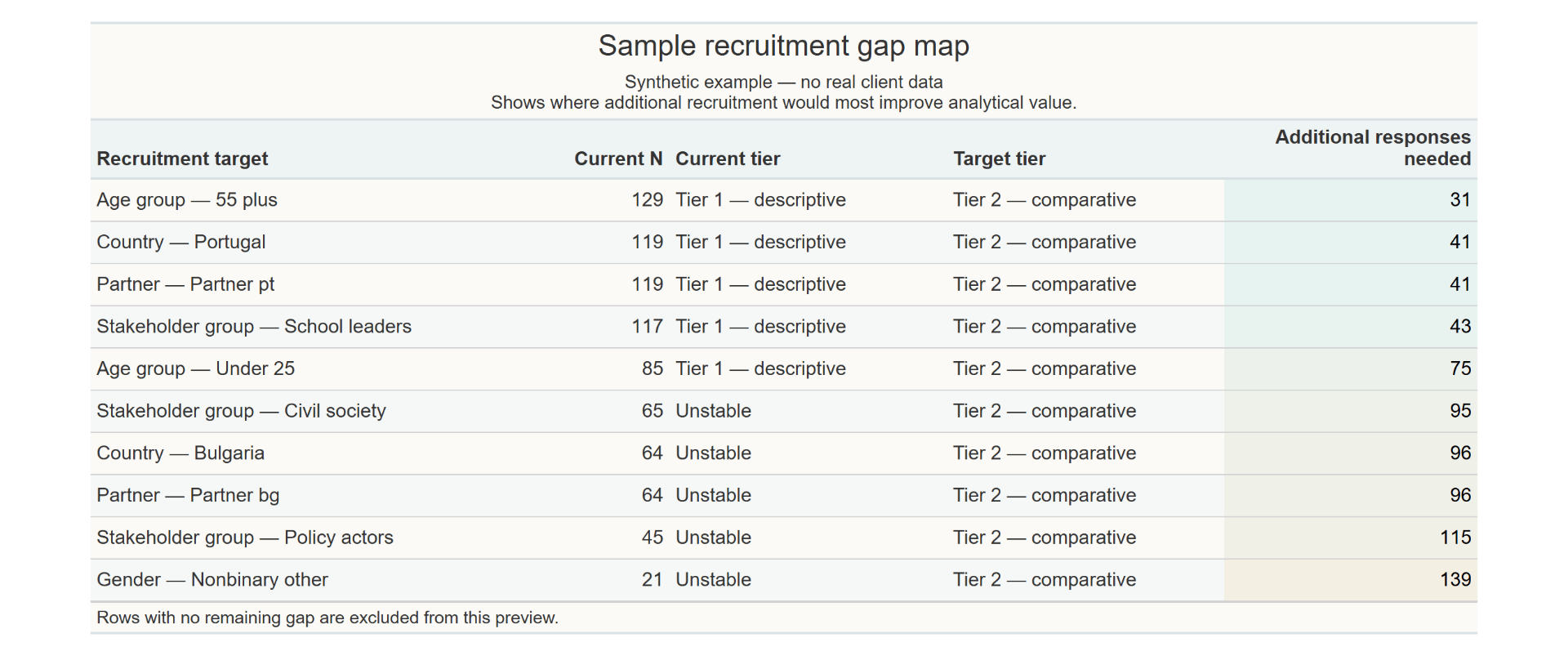
Synthetic example — no real client data
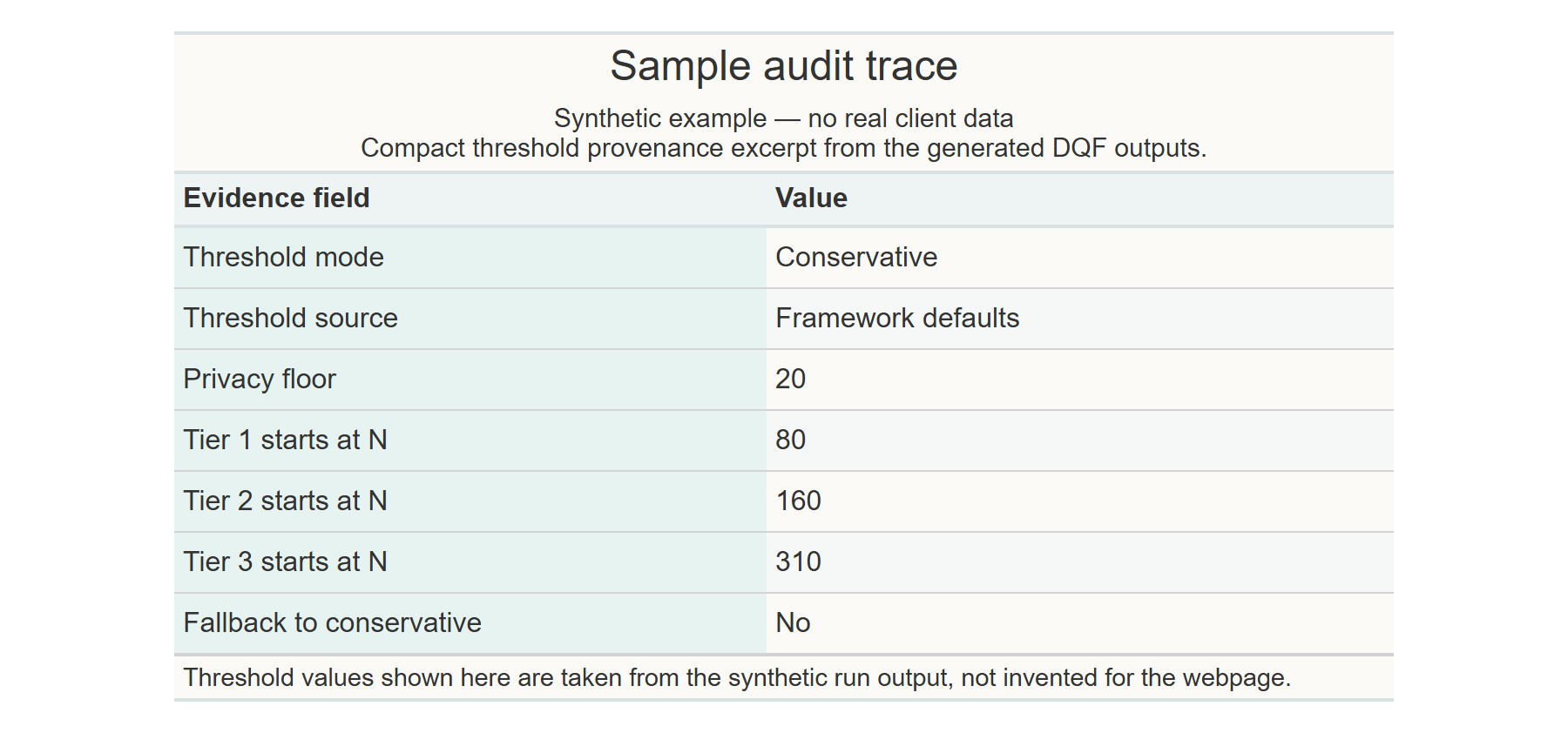
Synthetic audit-trace excerpt
Synthetic example. Thresholds, exclusion rules, and module-level evidence behind each reporting decision.
Synthetic example — no real client data
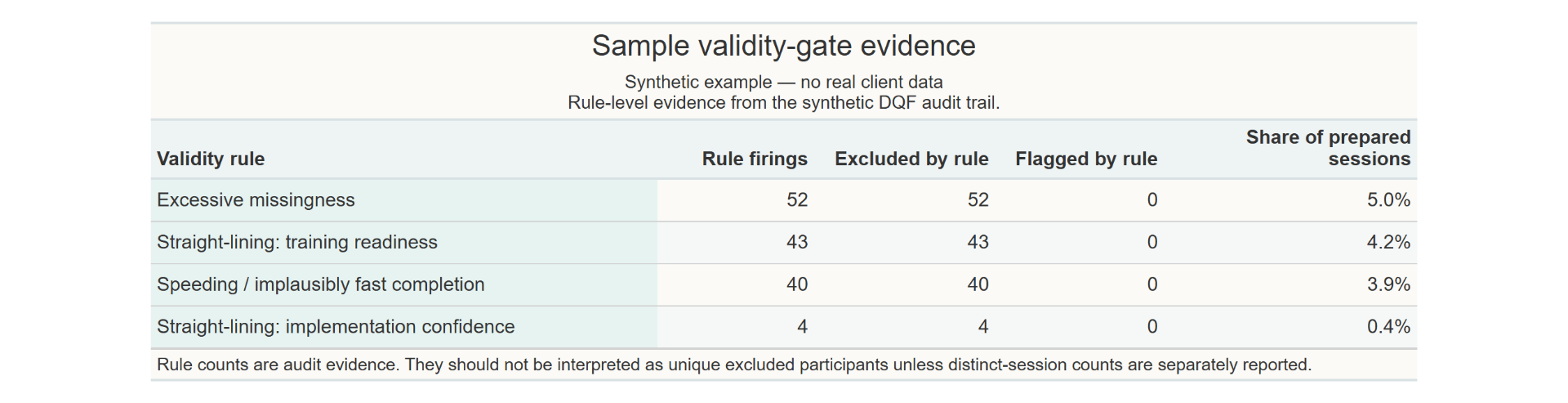
Synthetic exclusion-evidence excerpt
Synthetic example. Which validity rules fired and how many responses each removed.
Plan. Monitor. Audit.
Three entry points — recognise your own. Not every engagement needs all three.
Plan
- before/early collection- Define intended analysis routes
- Identify critical groups & outcomes
- Establish readiness assumptions
- Set monitoring & recruitment priorities
Monitor
- during collection- Track valid, outcome-complete bases
- Identify limiting groups
- Review phase/source/temporal shifts
- Prioritise recruitment by analytical value
Audit
- after collection- Review analytical intent
- Apply validity & admissibility checks
- Produce the final readiness map
- Define reporting boundaries & caveats
Analyst-led, audit-ready workflow.
Review
Research design and raw export.
Prepare
Shape into DQF-ready analytical data.
Map the structure
Translate the dataset into a declared research structure.
Intent
Declare analyst intent and readiness targets.
Deliver
Run DQF and deliver reports.
What DQF is - and is not.
With a methodological audience, what we refuse to claim is as persuasive as what we promise.
Not generic or automatic data cleaning. Preparation is transparent, recorded, and analyst-governed.
Not a self-service CSV upload tool. DQF needs a declared design and a supported data type.
Not a statistical findings engine. No p-values, effects, models, or conclusions are produced.
Not a GDPR, funder, or audit certification service. DQF produces evidence, not certificates.
Built for evidence that has to hold up.
EU-funded and social-sector surveys carry obligations ordinary market research doesn't: multi-country and multi-partner samples, surveys with individuals, and reporting that funders, evaluators, and reviewers will scrutinise. DQF is built for exactly this — it makes the readiness of your evidence explicit, and gives you the trail to stand behind every reporting decision.
Is your project a good fit.
Good fit
- Structured online surveys
- Supported IAT-style behavioural datasets
- EU, evaluation, policy, or applied research projects
- Multi-country, multi-partner, or subgroup comparison studies
- Projects needing defensible reporting boundaries
Not a good fit
- Arbitrary CSV uploads
- CRM / BI spreadsheets
- Qualitative text corpora
- Unsupported behavioural designs
- Fully automated self-service analysis
- Projects seeking automatic p-values without analyst review
What DQF checks.
Response validity
Keep, flag, or exclude responses.
Comparability
Can phases, partners, countries, or waves be combined?
Subgroup strength
Are groups large enough for the intended reporting?
Stability over time
Did recruitment waves change the data?
Recruitment gaps
Where would more responses improve readiness?
These checks feed the analysis-readiness and reporting-boundary decisions shown in the reports.
DQF does not run statistical tests or state findings. It shows what analysis routes the data can responsibly support.
Frequently asked.
Not a self-service upload tool. DQF is an analyst-led Headway service, supported by an internal analytical engine that automates the repeatable checks.
No. DQF needs a declared research design, a row unit, outcomes, subgroup structure, and a supported data type — not just any spreadsheet.
Yes. DQF can audit a completed dataset and show what can be reported, caveated, restricted, or left out.
Yes. DQF can monitor subgroup strength, recruitment gaps, and readiness unlocks while collection is still open.
No — and that's deliberate. DQF tells you which analyses your data can support. The findings, and what they mean, stay with your analysts.
Request a dataset-readiness review.
Tell us:
- Study type
- Collection status (planned / in fieldwork / complete)
- Approximate sample size
- Countries / partners / groups
- Intended outcomes & comparisons
- Main concern
- Whether fieldwork is still open
Start the form